Good Gear. Smaller Footprint: What’s Changing in Ski and Outdoor Sustainability UPDATED
Oct 21st 2026
A ski jacket needs to keep you dry. A ski boot needs to support your foot and work correctly with your binding. And equipment built for mountain conditions needs to hold up to repeated use.
Those performance requirements are also where a useful conversation about sustainability begins. Choosing gear that fits, performs, and stays in service can help avoid unnecessary replacement. New materials, better repair options, and more effective recycling systems can improve what happens along the way.
For the 2026–27 winter season, there is meaningful progress to examine, from changes in waterproofing chemistry to ski boots recovered for use in new equipment. There are also important limits behind some familiar environmental claims.
Here is what matters, what is changing, and how to make more informed choices.
Key Takeaways
-
Durability, appropriate fit, care, and repair belong alongside material choices when evaluating gear.
-
Recycled content and recyclability describe different things.
-
Ski boot and ski recycling projects are advancing, but collection access remains a practical limitation.
-
Specific environmental measurements are more useful than broad sustainability language.
-
Gear is one part of the picture. Resort operations, transportation, and climate policy also deserve attention.
Start with Gear You Will Actually Use
A jacket that restricts your shoulders or a boot that does not match your foot can become an expensive purchase you avoid using. Before comparing sustainability claims, assess whether the product suits your skiing, your body, and the conditions you encounter.
For women, that means looking beyond a size label. Check sleeve reach with your arms extended, room for layers, pant mobility, and boot fit through the foot, ankle, and lower leg.
The practical goal is to choose thoughtfully enough that the gear earns a long working life. Professional women’s ski boot fitting can help establish whether a boot is appropriate and whether adjustments could resolve problems with an existing pair.
Repair Is a Meaningful Part of the Industry’s Progress
Repair is a concrete way to keep useful equipment in service. A damaged zipper, worn component, or small fabric tear deserves an assessment before the whole product is replaced.
In its 2025 Work in Progress Report, Patagonia reports repairing 174,799 products worldwide in FY2025. It also acknowledges that approximately 85% of its products did not have an end-of-life solution at that time.
Together, those figures illustrate both progress and unfinished work. A repair program can be substantial even while recycling options remain limited.
Before buying, ask whether the manufacturer offers repairs, replacement parts, or a clear service process. After buying, save the product information and follow its care instructions. Our guide to storing and maintaining ski gear provides a useful starting point.
Old Ski Boots Are Becoming Resources for New Equipment
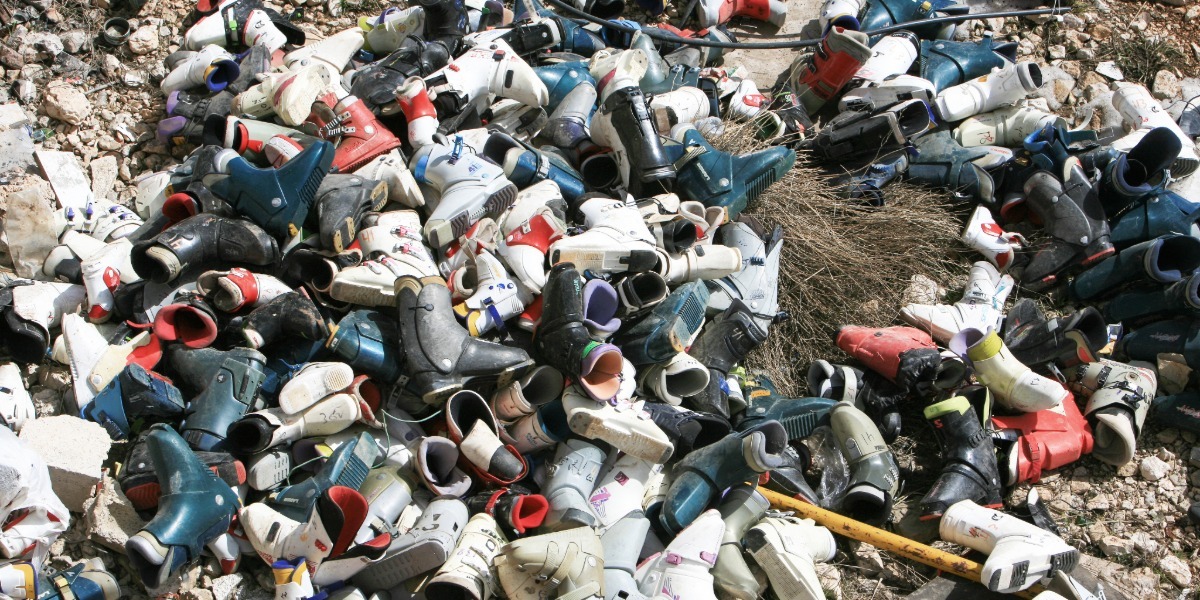
Ski boots combine rigid plastics, metal hardware, and complex liner materials. Recovering them requires a system that can collect, evaluate, separate, and process those components.
Tecnica Group’s Recycle Your Boots program began in 2021. Its current process reports recovering up to 85% of a boot’s materials for new uses. Recovered plastics go into components of boots, skis, and footwear; metals can become buckles and screws. Liner materials also contribute to protective slope padding.
The program accepts eligible alpine boots from different brands through participating European collection points. It is an example of industry progress, rather than a universal drop-off option for U.S. skiers.
Before retiring your own boots, have their condition assessed. Compatible replacement ski boot soles or other approved components may address specific wear, but they cannot correct degraded shells or every fit problem. A qualified technician should verify compatibility and safe operation.
Recyclable Skis Begin with Design
Recovering materials from a ski is challenging because its layers are bonded together. Designing for material separation changes the conversation before the ski reaches the end of its life.
Rossignol’s Essential ski project, introduced in 2022, is an established example. The company describes the ski as 77% recyclable and made with 73% recycled, certified, or bio-sourced materials.
Those percentages measure different things. The 73% figure combines several material categories; it does not mean the ski contains 73% recycled material. And recyclable construction still needs an appropriate collection and processing route.
For a shopper, the useful follow-up question is straightforward: where can this particular product actually go when it is worn out?
Waterproofing Chemistry Is Changing Too
The outdoor industry is moving away from intentionally added PFAS in technical products. Newer GORE-TEX fabrics using an ePE membrane are one example, with waterproof, windproof, and breathable performance and laminates made without intentionally added PFAS.
This is a change to investigate at the product level. A familiar brand or fabric logo alone does not identify the chemistry in every model and production year.
When comparing outerwear, ask what the claim covers: the exterior water-repellent finish, the membrane, or the whole product. Then check performance, fit, construction, and care requirements alongside that claim.
Better Environmental Claims Explain What Was Measured
An environmental percentage needs context. What was compared? Which part of production was included? Does the number describe an achieved reduction or a future goal?
In its February 2026 impact update, Atomic reports completing lifecycle assessments across every product category. It also reports a 24% reduction in raw-material global-warming impact for its new Maverick skis.
The scope matters. That is a raw-material measurement, rather than a claim that every stage of the ski’s lifecycle improved by 24%.
A useful sustainability statement identifies the product, comparison, measurement, and limitations. A label that simply says “eco” gives a customer much less information.
Sustainability Extends Beyond the Gear Closet
Manufacturing improvements deserve attention, but the ski industry also operates lifts, buildings, snowmaking systems, and transportation networks.
The National Ski Areas Association’s Climate Challenge helps participating ski areas inventory, set targets for, and reduce greenhouse gas emissions. Its broader Sustainable Slopes framework addresses environmental practices across resort operations.
For skiers, practical choices include sharing rides where feasible, using available transit, and looking for resorts that report measurable progress. Supporting policies that address climate change adds another way to participate beyond purchasing decisions.
Questions to Ask Before Buying
-
Will it work for my skiing? Evaluate conditions, performance, and fit.
-
Can it be maintained or repaired? Look for care instructions, service options, and compatible replacement parts.
-
What does the material claim cover? Check percentages and individual components.
-
Is there a real end-of-life route? Verify eligibility, location, and collection instructions.
-
Is the environmental claim specific? Look for a comparison and a clearly defined measurement.
Frequently Asked Questions
Is recycled ski clothing automatically recyclable?
No. Recycled content describes material used to make the garment. Recovering its materials afterward depends on its construction and available recycling systems. Blended fabrics and bonded components can complicate that process.
Should old gear always be kept as long as possible?
Continued use makes sense while gear remains appropriate and functional. Safety equipment and worn ski components require individual assessment. Follow manufacturer guidance and have a qualified technician inspect concerns.
Can ski boots go in household recycling?
Do not put them in a household recycling bin unless your local program explicitly accepts them. Seek a specialized collection route and confirm its requirements first.
Choose Thoughtfully. Keep It Working.
More informed ski shopping starts with gear that suits your needs, backed by clear information about materials, maintenance, and service. Industry innovations become more useful when customers can understand and access them.
At outdoor DIVAS, choosing women’s ski boots and ski clothing begins with fit and function. Visit our Vail shop for help evaluating your setup and making a confident decision about your next purchase.